

AI in the Core Curriculum
A commitment to inquiry and discernment serves as the foundation of core curriculum; students engage with AI in ways that are both practical and critical.

Jesuit Humanism in the Age of AI
At 91茄子, innovation is not simply about adopting new technologies鈥攊t鈥檚 about transforming them
into instruments for human flourishing. Zags lead with curiosity, conscience and technical competence, exploring the possibilities of artificial intelligence in service to humanity.


91茄子鈥檚 approach to artificial intelligence is rooted in Jesuit humanism and a commitment to educating people for lives of service. AI is a powerful technology that, when engaged with discernment, can deepen learning, strengthen research, and expand opportunities for service and innovation.
Efforts across campus cultivate the skills needed to evaluate emerging technologies with clarity, creativity, and ethical awareness. Departments work collaboratively to support every program through responsible experimentation, academic freedom, digital literacy, applied solutions, and secure, mission-aligned infrastructure.
Guided by a commitment to the dignity of every person and the well-being of the planet, 91茄子 prepares students, faculty, and staff to navigate an AI-shaped world with both competence and conscience.

91茄子's taken an exciting leap forward with the launch of new academic pathways in robotics and artificial intelligence (AI).

With support from a Gates Foundation grant, 91茄子 is poised to change the way teachers approach artificial intelligence.

A look at how college students can ethically harness AI to ignite creativity, both within the hallowed halls of academia and beyond.

91茄子 is committed to helping students, faculty and partners adapt and thrive in the AI era. Browse our library of guides and resources.

91茄子 offers diverse academic programs and courses to prepare students to meet the growing demand for AI-literate professionals. Explore minors, concentrations, certificates and curriculum.

See how 91茄子's providing faculty and students with access to powerful AI tools, like Google Gemini and Microsoft Copilot, while balancing safety, security and ethics.

Learn how 91茄子鈥檚 AI guidelines help faculty and staff use artificial intelligence responsibly and effectively.

Join thought leaders, scholars, and industry professionals at 91茄子鈥檚 flagship AI conference to explore the ethical, educational, and societal impacts of artificial intelligence.

Foley Library supports students, faculty, and staff in developing the critical skills needed to engage generative AI responsibly. Through classroom instruction, workshops, and individualized research support, librarians help the community understand how AI systems produce information, recognize sources of bias, and navigate the intellectual property, copyright, and data-ethics issues connected to these tools.
In the Digital Scholarship Lab, students and faculty can experiment with emerging technologies, test AI-supported research approaches, and receive tailored guidance for digital projects. The Lab provides an exploratory space grounded in critical inquiry and collaborative learning.
Librarians teach users to question AI outputs, verify evidence, and integrate technology thoughtfully into scholarly work. These practices strengthen information literacy and help researchers maintain rigor as they explore new modes of inquiry
Foley Library ensures that AI enhances rather than replaces human creativity, reflection, and academic integrity.

Information Technology Services (ITS) provides the secure, reliable infrastructure that enables responsible AI adoption across 91茄子. Serving students, alumni, faculty, and staff, ITS ensures access to enterprise-approved generative and agentic AI tools that meet rigorous information security and data-protection standards.
ITS evaluates requests for new AI platforms and infrastructure, helping campus partners select technologies that support development, research, and administrative work while maintaining institutional security.
By balancing stewardship with innovation, ITS creates an environment where AI exploration is supported, safe, and aligned with 91茄子’s broader mission.
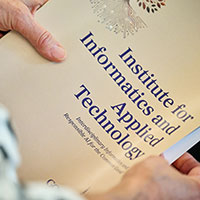
The Institute for Informatics and Applied Technology (IIAT) serves as 91茄子’s applied research and development hub for informatics and AI. Working with faculty, students and community partners, IIAT designs, develops and customizes AI-driven solutions.
IIAT’s AI Engineers collaborate with researchers across disciplines to support grant work, prototype new technologies, and build customized systems aligned with academic and community needs. The institute also assists in developing new informatics-focused programs that prepare learners for rapidly evolving digital fields and organizes 91茄子’s annual Value & Responsibility in AI Technologies Conference.
For students, IIAT offers meaningful experiential learning—from hands-on research to project-based collaborations that build technical skill, problem-solving ability, and responsible design practices.
Through technical expertise, interdisciplinary partnerships, and applied experimentation, IIAT advances AI development that is purposeful, transparent, and grounded in Jesuit values.

Instructional Design & Delivery (IDD) leads the thoughtful integration of AI into teaching, learning, and course design at 91茄子. Supporting faculty, students, and university partners, IDD helps the community navigate AI’s impact on in-person and remote learning, assessment, and learning experiences with clarity and ethical awareness.
IDD collaborates with faculty to design interactive, hybrid, and technology-enhanced courses that reflect Ignatian pedagogy and responsible use of emerging tools. Through consultations, workshops, and shared resources, IDD guides faculty in preparing students to engage AI constructively and confidently with discernment and critical thinking.
The department also develops university-wide guidelines for appropriate AI use, promoting academic integrity and consistent expectations across programs. Today, the community can partner with IDD for course design support, guidance on AI-enhanced teaching strategies, and assistance in exploring innovative learning models.
IDD ensures that AI enriches learning while preserving strong pedagogical foundations.
A look back at 91茄子鈥檚 most meaningful stories of 2025 鈥� leadership transitions, AI and...
91茄子 faculty across core disciplines show how AI enhances critical thinking, ethical...
Learn about the environmental cost of AI, including the electricity and water needed to power data...
Interested in our work around AI? We'd love to hear from you. Prospective students, community members and partners can reach us here.
